Search or pick a situation. We tell you what to do, what to avoid and where to check.
🔍
Start with what is happening
➡️17 answers
Not categories. Chapters of city life.
Guides to keep in your pocket
01
🧭
Your first 24 hours in Pisa
6 answers+−
01Taking a train: ticket and platformAt Pisa Centrale, check the train number, time and platform on the departure boards. Validate the single paper regional ticket before departure. The Digital Regional Ticket (BDR) activates automatically at the scheduled departure time of your chosen train.
✅Do this
At Pisa Centrale, check the train number, time and platform on the departure boards. Validate the single paper regional ticket before departure. The Digital Regional Ticket (BDR) activates automatically at the scheduled departure time of your chosen train.
⛔Avoid
With a BDR, do not board another train without changing your ticket: change the time before the scheduled departure. At inspection, show the BDR on your device with its dynamic green bar and a valid ID if they ask.
❓Why
The BDR is only valid on another train if you change it first. Trenitalia keeps the BDR, the Electronic Regional Ticket (BER) and paper tickets apart: their rules do not interchange. Follow announcements.
One question
Do you need a route without stairs or help boarding?
Yes
Request Sala Blu assistance before travelling; the RFI page lists services and accessibility. RFI lists lift operating hours of 05:30–01:30; also check for outages.
No
Check the platform again before boarding. For the BER and other tickets, read your ticket conditions: the BDR rule does not apply to every online purchase.
02Leave luggage near the stationChoose from two private storage facilities near Pisa Centrale: Baggy Lockers, Via Catalani 5, lists 06:00–23:00; Stow Your Bags, Via Cristoforo Colombo 6, lists 07:00–23:00. See their website for availability, locker sizes and the price for your storage time.
✅Do this
Choose from two private storage facilities near Pisa Centrale: Baggy Lockers, Via Catalani 5, lists 06:00–23:00; Stow Your Bags, Via Cristoforo Colombo 6, lists 07:00–23:00. See their website for availability, locker sizes and the price for your storage time.
⛔Avoid
Do not trust the name: “station” does not mean an entrance inside the station. Do not choose by the starting price alone: check the duration, locker size and collection time.
❓Why
They are private businesses: they set their own hours and rates. The rate is per locker, not per bag; how many bags fit depends on their size.
One question
Do you need to collect your bags after 23:00?
Yes
So these two are not enough: both operators list a 23:00 closing time. Collect earlier or find another option before leaving your bags there.
No
Keep the confirmation and access code, check the address and allow time to collect everything before your train.
06Piazza dei MiracoliThe Cathedral is free but you need a timed ticket: get it at the ticket office. If you have one for another monument, the Cathedral is included: keep it for the toilets.
✅Do this
The Cathedral is free but you need a timed ticket: get it at the ticket office. If you have one for another monument, the Cathedral is included: keep it for the toilets.
⛔Avoid
With children, don't treat the Tower like the other monuments: check the rules first.
01Bus without a fineIn town, match the ticket to the action: paper → validate it; app → activate it; bank card or phone → tap as soon as you board and wait for the green light. A Pisa urban ticket lasts 70 minutes.
✅Do this
In town, match the ticket to the action: paper → validate it; app → activate it; bank card or phone → tap as soon as you board and wait for the green light. A Pisa urban ticket lasts 70 minutes.
⛔Avoid
A red light: payment failed. Try again. If it stays red, you do not have a valid ticket. Do not change card or device: inspection needs the one you paid with. One card covers one passenger.
❓Why
The ticket says you paid, not that you are travelling: it is the action that ties it to this ride. Without validation, activation or a tap, Autolinee Toscane can fine you.
The fine, in numbers
Urban service
within 15 days
€40 + €3
days 16–60
€80 + €3
after 60 days
€240 + €3
Fine + cost of the onboard ticket.
One question
Leaving Pisa or heading to the coast?
Yes
The service may become suburban or mixed-fare. With Tip Tap, tap on and tap off; if you miss the second tap, you are charged to the terminus. Check the line before leaving.
No
On city buses, tap every time you board, including transfers within the 70-minute validity. With a paper or digital ticket, follow its rule: validation or activation.
01Duty pharmacyFind a nearby pharmacy and check the rota on the sign posted outside every pharmacy. Farmacia Comunale n. 5, via Niccolini, declares it is open 24 hours a day. Emergency? Call 112.
✅Do this
Find a nearby pharmacy and check the rota on the sign posted outside every pharmacy. Farmacia Comunale n. 5, via Niccolini, declares it is open 24 hours a day. Emergency? Call 112.
⛔Avoid
Do not trust copied opening hours: nights, holidays and duty rotas change.
❓Why
The map does not say which one is on duty: that is why Tuscan regional law requires the sign outside every pharmacy.
02A doctor while studying away from homeDo you study or do a PhD in Pisa, and is your GP far away? Read the official requirements and documents, then choose: temporary healthcare domicile, or the University service for non-resident students.
✅Do this
Do you study or do a PhD in Pisa, and is your GP far away? Read the official requirements and documents, then choose: temporary healthcare domicile, or the University service for non-resident students.
⛔Avoid
Do not wait until you are ill to decide. Out-of-hours medical care does not replace a GP; call 112 in an emergency.
❓Why
Temporary healthcare domicile lasts from three months to one year and can be renewed. Students and PhD candidates who do not transfer it can consider the University alternative for non-residents.
One question
Do you want to transfer your GP to Pisa temporarily?
Yes
Prepare a domicile self-certification, suspension from your home GP and proof of enrolment, then contact the local health authority.
No
Check the University service for non-resident students and the conditions shown on the portal before joining.
03Dispose of household waste correctlyLook up your address in the Geofor calendar. Historic centre and coast: residents use card-operated electronic bins. Elsewhere: door-to-door collection.
✅Do this
Look up your address in the Geofor calendar. Historic centre and coast: residents use card-operated electronic bins. Elsewhere: door-to-door collection.
⛔Avoid
Do not leave furniture, appliances or bags beside the bins. Book a collection or use a recycling centre for bulky waste.
❓Why
The system changes by area, and incorrect disposal may be fined.
One question
Do you need to dispose of furniture or an appliance?
Yes
Book the free Geofor collection and follow the instructions you receive. Do not leave anything in the street without a booking.
No
Open the City service and use the calendar and waste guide for your address.
05Evening: what stays openPharmacy? Farmacia Comunale n. 5 (via Niccolini) declares it is open 24 hours a day. Taxi? Co.Ta.Pi. declares a 24-hour radio taxi: 050 541600. Non-urgent medical care at night? The Tuscany Region gives 116117. Emergency: 112.
✅Do this
Pharmacy? Farmacia Comunale n. 5 (via Niccolini) declares it is open 24 hours a day. Taxi? Co.Ta.Pi. declares a 24-hour radio taxi: 050 541600. Non-urgent medical care at night? The Tuscany Region gives 116117. Emergency: 112.
⛔Avoid
Check the PisaMover timetable for the day: the operator lists service until 24:00, and until 01:00 from June to September. During the evening periods marked with an asterisk, the shuttle run requires a specific call.
❓Why
Every hour here is declared by a different operator on the date checked.
01Lost phone or documentsBlock cards and your SIM immediately. Then report lost or stolen documents to the authorities. Near the Duomo, the Tourist Police too takes reports from visitors on its service days: check the municipal schedule before going.
✅Do this
Block cards and your SIM immediately. Then report lost or stolen documents to the authorities. Near the Duomo, the Tourist Police too takes reports from visitors on its service days: check the municipal schedule before going.
⛔Avoid
Do not wait for them to turn up before blocking payments and access. Do not post photos of your documents.
Check your departure and decide when you start heading back. Choose a few stops from the collection, which is ordered by distance from Piazza della Stazione. Two hours is the title: the real time covers getting there, the stops and the return.
Do this
Step 1 of 8. Before heading out, check your train through the operator's channel. Write down the time and the train number where you can read them even if your phone is out of battery. Decide what time you start heading back: the margin depends on your pace, on your luggage and on getting around the station.
Step 2 of 8. The collection orders the points from the nearest to Piazza della Stazione, within 800 metres in a straight line: streets, crossings and entrances make the walking route longer. If you are not starting from the station, count the route from where you are.
Step 3 of 8. To leave a suitcase, open the luggage storage card: it lists two private luggage storage points which, at the date of the check, both close at 23:00; availability and conditions are on the operator's website. If you get back later, collect it earlier or do not leave it. Drop-off, waiting and collection all take time out of your stop: count them.
Step 4 of 8. Open What to see and choose a first stop. Tuttomondo, Keith Haring's mural in Largo Keith Haring, is a landmark to look for on the map: the section only shows the nearest ones. Before setting off, check the card and the route; the second place comes afterwards.
Step 5 of 8. Use the Water and Toilets sections if you need them. Nearby does not mean available: in the card read the location, the source and the known conditions, whether it has access restrictions or sits inside a building; on site, check the opening hours and the signs. If a point does not work, change it, counting your return.
Step 6 of 8. The Pharmacies section holds the collection's points; check the opening hours. At night or on public holidays the pharmacy on duty may be another one, outside this section: you read which on the notice outside every pharmacy.
Step 7 of 8. After each stop, look at the time you have left. If an entrance means waiting, if the route has obstacles or if you are tired, drop stops. If you have mobility needs, check the actual route: the radius says nothing about accessibility.
Step 8 of 8. Start heading back at the time you decided, luggage collection included, and check the departure again through the operator's channel; on the boards, compare the train, the time and the platform. Tickets and procedures are in the regional train card. For a bus, open the bus card and check the line and the time with the operator.
⚠️Avoid
Reading Two hours as a guaranteed duration, or as all the time you can spend away from the station.
Counting the 800 metres as the way you have to walk: they are in a straight line, and on foot it is more.
Trying to go through every section: it is not a fixed route, take what you need.
Leaving luggage collection out of the count until the last stop.
Extending your tour because you see a delay: you check the departure again through the operator's channel, not on the delay.
RUMBA S.r.l.
If the time you have left does not cover the return, luggage collection and getting around the station, stop sightseeing and return to your departure point.
🗓️Monday: what to see outdoors129 places · 5 sections
🗓️It is Monday in Pisa: how do I plan a visit without assuming every place is closed or open?
Monday in Pisa has no single rule. The Ministero della cultura's cards list the Museo nazionale di San Matteo and the Museo nazionale di Palazzo Reale as closed on Mondays; Piazza del Duomo follows the Opera della Primaziale Pisana's calendar. Choose a few exteriors from the collection, and check every visit with an entry separately.
Do this
Step 1 of 8. Start from the date: your Monday is one particular day, not a rule. If what you wanted was the Museo nazionale di San Matteo or the Museo nazionale di Palazzo Reale, the Ministero's cards list them as closed on Mondays. Check the notices for that date anyway: a special opening is something you confirm with the operator, and these two museums' closure does not apply to the others.
Step 2 of 8. Open City gates, Squares or Memorials and monuments and choose your first stop from where you are, or from where you will be starting. The collection does not state a starting point or a radius: the order of the sections is only a list. The map gives the distance as the crow flies, not the walk: look at the streets before you move.
Step 3 of 8. In the Towers section, choose what to look at from outside. A tower on the map does not tell you that you can go in or climb it: the inside depends on the operator's conditions, availability and hours. If seeing it is enough for you, choose where to look at it from along a permitted route, without counting on courtyards or internal passages.
Step 4 of 8. For the Piazza del Duomo complex, look at the Opera della Primaziale Pisana website: it publishes its own calendar and warns that hours and openings can change without notice. If you want to climb the Tower, the ticket is tied to a time: check availability and the time slot before counting on it. Seeing the exteriors does not give you access to the monuments.
Step 5 of 8. If you add Green areas, look for the entrance first: some areas are fenced and keep opening hours, and the collection has no reliable shade data. For the lawns of Piazza del Duomo, the Opera's FAQs say where you may stop and where you may not: follow the signs, not all of the lawn is open for stopping.
Step 6 of 8. Leave room for a break. Water and toilets have their own category on the map: open the card of the point that suits you and read its source and conditions, because nearby does not always mean accessible or free. For an indoor stop, check the hours of the place you choose, for your Monday: its own calendar applies, not San Matteo's.
Step 7 of 8. After the first stop, pause and take stock: tiredness, weather and the time left. You can choose another exterior or finish here: you do not have to go through every section. If you have mobility needs, check the actual route, crossings and entrances included: a place on the map does not tell you that the walk suits you.
Step 8 of 8. Before extending the tour, recheck where and when you have to be back; if you have left your bags in luggage storage, count the collection in too. For trains, luggage storage and buses, use the linked cards and the operator's channel. If you are still sorting out your arrival, open First day in Pisa. Extra visits come after the time for your return, not before.
⚠️Avoid
Turning San Matteo's and Palazzo Reale's Monday closure into a rule for every building, library or monument: the Ministero's cards speak only about those two sites.
Reading a tower, or a place listed as outdoors and with no ticket, as a promise of free entry or of a climb: going in depends on the operator's conditions and hours.
Reading the collection as a tour already measured from the station, or from where you are: it does not state a starting point or a radius.
Assuming every garden is open, or every lawn can be walked on, because the point is on the map: some areas are fenced and keep opening hours, and there is no reliable shade data.
Adding stops, or a climb time slot, without factoring breaks, luggage collection and your return back in.
RUMBA S.r.l.
If an entry is not confirmed, stay with the exteriors or drop a stop. If the route does not suit you, or leaves no time to get back, stop and sort out your return first: ask the transport operator, and the site's operator about the entry.
Many state museums close on Mondays. Here you will find outdoor places with no ticket. Gardens and the Tower complex may keep their own hours: open the card before going.
🎓I'm starting to study in Pisa: how do I find a library and organise my first steps?
First decide what you need to do: study with your own notes, consult a book or take it home. The right location depends on that. The collection brings together libraries, water and bikes; for university steps, use your university's official portals.
Do this
Step 1 of 8. Decide what you need today and how much time you have before your class or your return. If you study at UniPi, start from the Students page and look for your course. The welcome tutoring service is meant for first-year students, and the contact is the course's academic office: ask there how to start and which services you have.
Step 2 of 8. You get into Alice from UniPi's Students page. If you still have to register, or to activate Wi-Fi and library services, follow the credentials guide: logging into Alice does not activate them on its own. If something does not work, that same guide points to official support. For your course, the published instructions apply: the map does not complete an enrolment.
Step 3 of 8. Open Other libraries and UniPi libraries and see which location sits between where you are and where you are going next. The collection does not state a starting point or a radius: you judge the distance yourself. On the card, read who runs the place: the operator makes the rules.
Step 4 of 8. In the UniPi libraries, the Service Charter also admits external users who are adults, with possible limits on borrowing and resources. Before going, open the location's page: opening times, notices and access arrangements are there. For the other libraries, the collection does not say how you get in: check each one's website.
Step 5 of 8. If you need a text, look for it in the catalogue the library indicates: see which location holds it, whether it is available and on what conditions it is lent. For UniPi that is OneSearch, which also shows reservations. Entering, taking a book home and reading digitally are three services with different conditions: for digital, your credentials and user category count.
Step 6 of 8. Before relying on a location for a whole session, ask whether the seat has to be booked and whether you may use your own materials; ask about sockets and connectivity too, if you need them. If you have mobility needs, check the entrance, the floor the room is on and the route: the point on the map says where the library is, not what it is like inside.
Step 7 of 8. Water without a badge gathers the points with no recorded access restriction: it does not say that they work today. Before setting off, read the source and known conditions on the card, and whether the point is inside a building or has access limits; on site, the signs apply. If you choose Shared bikes, check availability, cost and where you can end the hire in the operator's app, before counting on the bike for a journey.
Step 8 of 8. Keep a second location ready, checked in the same way, in case the first is closed, full or unsuitable. Before you change, do the sums again: time to study and time to get back, plus the collection time if you have left your luggage, because the luggage storage has set hours. Train, luggage storage and bus are in the linked cards; for arrival services, open First day in Pisa.
⚠️Avoid
Confusing entering, borrowing and reading digitally: three services, three sets of conditions.
Taking access to Alice as confirmation of enrolment.
Assuming a seat, sockets, connectivity or accessibility are available because a library is on the map.
Reading the collection as a tour already measured from the station: it does not state a starting point or a radius.
Trusting a class or your return to a bike you do not have yet, or drinking at a water point without having read its signs.
RUMBA S.r.l.
If you cannot confirm access, or a condition you cannot study without, ask the library before setting off or change location. If the problem is your course or your credentials, contact the academic office or your university's official support.
☔Rain: where to stay indoors111 places · 2 sections
☔It is raining in Pisa: how do I choose somewhere indoors without going from one closed door to another?
Choose a single destination and check its opening and conditions before you move. The collection finds them for you, with no need to buy anything; whether the door is open today, and whether you can stay, is something the card or whoever runs the place tells you.
Do this
Step 1 of 8. Before you change your plans, check the weather and any alert from Regione Toscana. If there is an alert, follow the municipality's instructions: that is where the regional system sends you. This collection is for an ordinary indoor stop: it does not point out safe shelters and says nothing about the route.
Step 2 of 8. Note where you are and where you have to get back to. Open Libraries and study rooms or Open churches and compare each destination with the point where you actually are: the collection does not state a starting point or a radius, and the first on the list is not necessarily the nearest. Look at the route to the entrance before you leave.
Step 3 of 8. Read the card for the place and then the page of whoever runs it, for today's date: notices, opening, who may enter. If you want to stay and read or wait, ask whether that is allowed and whether there is space. Open churches is the title of a section, not a check made today: do not set out on the strength of the name.
Step 4 of 8. If you choose a library, stay within the rules of the reading room: reading and consultation. To be checked: the Comune di Pisa presents SMSBiblio, at via San Michele degli Scalzi 178, as a public lending and reading library. Its page gives opening hours by period, with the closures: read the one valid for your date and weigh up the route. SMSBiblio is an external reference, not a point in the collection: in the collection each library has its own card.
Step 5 of 8. If you choose a church, go in only if it is open and access is allowed. It is a place of worship: respect services, silence and the instructions of whoever runs it, and do not count on staying during a service. If you want to sit down or stay for a long time, ask first. A church does not become a waiting room because it is raining.
Step 6 of 8. Before you arrive, think about what you are bringing in with you: luggage, an umbrella, a wet jacket. Check on the card or with the place whether you can go in like that: access differs from place to place. If you have mobility needs, check the entrance, steps and the space you use. If you need a toilet, ask whether there is one and on what terms: being indoors does not include facilities.
Step 7 of 8. During your stop, keep an eye on the weather and, if you have a time to keep, a train or luggage collection, on that too. If the place closes or can no longer welcome you, choose the alternative before you go out, including the way back to your accommodation or to your starting point: that way you go out only once.
Step 8 of 8. Decide on your return with luggage collection and the route to your departure inside it: luggage storage points state a closing time, and it is on the card. For trains, luggage storage and buses, use the linked cards and the operator's updates. If you still have to sort out your arrival, open First day in Pisa.
⚠️Avoid
Taking the title Open churches, or a point on the map, as proof that the door is open today.
Assuming you can wait a long time, take a seat, or go into a library or church with all your luggage.
Reading the collection's order as a distance from where you are, or as a short route through the rain.
Using this collection in place of alerts and the municipality's instructions when bad weather is dangerous.
Heading out to a second place without having checked its access, the route and the way back.
RUMBA S.r.l.
If you do not confirm access, or a stop that suits you, ask the operator before you move; with no answer, reconsider your destination. With an alert active, follow official updates and the municipality's instructions.
💊I need a pharmacy in Pisa: how do I check which one can help me now?
Choose a nearby location and open its card: read whether it is a pharmacy or a para-pharmacy. At night and on public holidays, check the duty rota on Federfarma Pisa and call before setting off. The map says where it is, not whether it is open or what it has.
Do this
Step 1 of 8. Open the Pharmacies and para-pharmacies section and see what you have nearby. Choose one you can reach and open its card: the name and address are there, not on the map pin.
Step 2 of 8. Read the full name on the card. The section may include a para-pharmacy, for example BioFarma - Parafarmacia & Erboristeria. If you need a pharmacy, or the duty rota, that location is not enough.
Step 3 of 8. At night and on public holidays, open Farmacie di turno on Federfarma Pisa and follow the Turni Farmacie Pisa link. Rotas change: check that the dates shown cover the day and time you are going, then compare the name and address with the card. Farmacia Comunale n. 5, in via Niccolini, states that it is open 24 hours a day: call it before going, like any other.
Step 4 of 8. If you are outside a closed pharmacy, read the notice outside: every pharmacy displays its opening hours and the pharmacies on duty. Check the date and address before moving on.
Step 5 of 8. Call, using the number on the card or from the rota source. Ask three things: whether it is open, whether it is on duty, and whether it has the product and the size you are looking for. That way you are less likely to cross the city for a closed door.
Step 6 of 8. Keep the exact product name to hand, your prescription if you have one, and the documents you are asked for. Prescriptions, substitutions and doses are decided by the pharmacist or the doctor: this guide takes you to the right door, no further.
Step 7 of 8. Open navigation from the card and check the actual route and the entrance, especially if you have mobility needs. Opening hours and accessibility on the cards come from OpenStreetMap and may be missing or out of date: opening and the entrance are confirmed by the pharmacy, on the phone.
Step 8 of 8. In an emergency, stop looking for a pharmacy: open SOS and use the contact for what you need, or call 112. This guide does not measure urgency: do not wait until you have found a pharmacy.
⚠️Avoid
Using a rota whose dates do not cover the time you are going: rotas change.
Believing a pharmacy is open now because the card shows opening hours.
Taking every location in the section for a pharmacy on duty.
Assuming a medicine, a size or a service is available without having asked the pharmacy.
Choosing a medicine, a substitution or a dose from this guide: that is for the pharmacist or the doctor.
RUMBA S.r.l.
If you cannot confirm the duty rota, opening, the entrance or availability, change pharmacy and call again. In an emergency, open SOS or call 112 straight away.
Find nearby pharmacies and health services. At night and on public holidays, check the current duty rota and call ahead; in an emergency use SOS or call 112.
🆓Squares, green spaces and water to find184 places · 4 sections
🆓I want to visit Pisa without adding expenses: where should I start?
Choose a few stops to look at from outside: squares and city gates, without planning indoor visits. Sort out water, your break and your return first. For each service, check its card for any costs and conditions, even if your aim is to spend nothing.
Do this
Step 1 of 8. Decide how much time you have and what you already carry: water, something for your break, what you need for the return. The possible expenses lie elsewhere: a bus, a toilet you pay for, a locker if you have luggage. Keep them separate from the visits, which remain optional.
Step 2 of 8. Open Squares and choose your first stop from where you are now. The order starts from a centre set by the map: the first one is not necessarily the closest to you. If Piazza delle Vettovaglie is there, read its card and check the route.
Step 3 of 8. If a city gate is on your route, add it: the card helps you recognise it, and you look at it from outside. Climbing the walls or entering a building is a different service, with its own conditions: if that interests you, check them first.
Step 4 of 8. For your break, open Green spaces and look for the entrance: the point on the map is the centre of the area, not a way in. Read the signs, opening times and conditions, and choose based on the route and your mobility. Shade and benches are not confirmed.
Step 5 of 8. The Water section excludes points with a recorded fault or restricted access. That does not prove they work today: an unrecorded fault is still a fault. Open the card, read its source and date, follow the signs on site. Keep some water in reserve and another point lined up, in case it is closed or out of order.
Step 6 of 8. The Acqua ad Alta Qualità facilities are run by Acque, which publishes a map of them and guidance on containers: if you are looking for one, start there. It is a separate list: it does not say which points in the collection are its facilities, nor whether they work today. Bring a container and follow the notices.
Step 7 of 8. If you add an indoor visit, an event or a service, ask whether a ticket, a booking or a payment is needed: not paying and not booking are different conditions. For a toilet, use the map category; the card gives only the known conditions: check the cost and the opening rather than inferring them from the title.
Step 8 of 8. After the first stops, decide: another one or the return, without going through every section. Keep time for your departure and your luggage: the luggage storage points have a closing time. Train, luggage storage and bus are in the linked cards; for your arrival, open First day in Pisa.
⚠️Avoid
Thinking a service costs nothing because you do not want to spend.
Mistaking an exterior on the map for an entry with no payment or no booking.
Reading the absence of a recorded fault as proof that the point works today, or that the water can be drunk.
Turning the collection’s order into distances from where you are, or into certain times.
Adding stops without counting luggage, services and the return back in.
RUMBA S.r.l.
If a stop asks you for an expense you do not want to make, choose another exterior or shorten your outing. If the water or a service you need cannot be used, find the alternative before going on: the collection’s title does not meet that need.
Open the water point that is easiest to reach from where you are. Read the source and date, then rely on what you find on site, and keep a second point ready. Toilets are in the collection, but you read opening and cost on their own card.
Do this
Step 1 of 8. First, look at which side of the Arno you are on and where you are going next. The collection takes the points within 600 metres in a straight line from Ponte di Mezzo and orders them from there: those are not walking metres from where you are, and the order is not a route.
Step 2 of 8. Open Water and look at the points in relation to you, not to the bridge. Piazza delle Vettovaglie and Piazza Cairoli, for example, are in the collection: if they are on the other side of the river, that is not a reason to cross. Choose the simplest route and keep the second one ready.
Step 3 of 8. On the card, read the point’s source and dates. The Water section already leaves out recorded faults and access restrictions; but a date and no reports do not tell you that water comes out today, or that it is drinkable.
Step 4 of 8. Once you are there, find the outlet and read the signs and notices before filling up. If it is closed, faulty, or a sign says not to use it, the sign is what counts, not the map marker: move to the second point you kept ready.
Step 5 of 8. The Acqua ad Alta Qualità dispensers belong to Acque, which states that the water they supply is free: that applies to those, not to every point in the collection. A point from OpenStreetMap or fontanelle.org is not Acque’s for that reason: before applying Acque’s rules to it, make sure it is theirs, from the source on the card or from Acque’s map.
Step 6 of 8. Bring a clean container. If the point is an Acque dispenser, read Acque’s guidance on containers and storage, and follow the instructions at the facility: a date on the card does not tell you how to keep the water.
Step 7 of 8. If you need a toilet, open Public toilets and read the card: the route to the entrance, accessibility, opening, cost. Many toilets charge a fee. A free label or a cost on the card is not today’s price; an empty field does not mean entry is free.
Step 8 of 8. If you have filled up, decide whether to carry on along the river. For a break from the heat there is It’s hot and I need shade: green spaces, churches and water, with shade and opening not guaranteed. Before extending the walk, count in your return and your luggage: the train, the luggage storage and the bus have their own cards; First day in Pisa has squares, city gates and palaces to look at from the street.
⚠️Avoid
Filling up at a point just because it is on the map: that does not say whether it works today, or whether the water is drinkable.
Taking every OSM or fontanelle.org point for an Acque facility.
Reading the 600 metres from Ponte di Mezzo as the distance you actually walk.
Extending the Acque dispenser’s free water to toilets or other services.
Insisting on a point that is closed or faulty instead of moving to the second one.
RUMBA S.r.l.
If the point cannot be used, move to the second one before going on. If the route does not fit your time, or does not suit your mobility needs, change area or plans: the collection does not ensure you a refill.
Water points and toilets within a geometric radius of 600 metres from Ponte di Mezzo, ordered from that reference. Choose your route from your position and check the source, access and signs on site.
Many toilets charge a fee. The card shows the conditions we know.
🌳It’s hot and I need shade204 places · 3 sections
🌳It’s hot and I want to stop in Pisa: how do I find a suitable break?
First choose where to stop, then the actual route to get there. Green spaces, churches and water help you search, but the map does not measure shade and does not confirm opening. Keep a second choice ready, close to the first.
Do this
Step 1 of 8. Decide how long you want to stop for and which stops can wait. Start from where you are and where you are going next: compare on the map the routes to the places that interest you and choose the shortest one for you. The list is not an itinerary to complete.
Step 2 of 8. Open Green spaces for a break and look at the shape of the area. The marker shows its centre, and the centre is not an entrance: find the entrance on the map, check it on site and work out your route from there, not from the marker.
Step 3 of 8. Once there, look for the shade yourself: the map does not measure it. See whether there is somewhere to sit, whether there are services and whether the space suits the break you want. The area being on the list does not tell you that you will find shade, seating or services there when you arrive.
Step 4 of 8. If you choose Giardino Scotto, also read the notices about use of the area: the Comune di Pisa publishes events there. Hours and conditions published for an event apply to that event, not to the park, and they do not tell you where the shade is.
Step 5 of 8. A church is a place of worship, not a shelter at your disposal. Read the card and the notices at the entrance: go in only if it is open and if entry is allowed, and inside respect services and silence. If you find it closed, you already have your second choice.
Step 6 of 8. Choose a water point for your stop and read the card: location, source and known conditions. Recorded faults and access restrictions are excluded, but nothing confirms that the water will be running when you arrive: read the signs on site. Acque’s Acqua ad Alta Qualità dispensers have a map of their own, with instructions for collecting water: that map does not confirm the points in this collection.
Step 7 of 8. Before you leave the first place, choose the second one to check. If the first is closed or does not give you the break you were looking for, you change destination, you do not add stops: the points in the collection are not compulsory stops.
Step 8 of 8. After the break, decide whether to carry on or head back. For water in the Lungarni area, open Water near the Lungarni. The regional train, luggage storage and buses are in the linked cards; for arriving in the city, open First day in Pisa.
⚠️Avoid
Taking a green space for a shaded area: nothing attests to it.
Heading for the marker: it is the centre of the area, not the entrance.
Reading an event’s hours as the park’s hours.
Assuming a church is open because it is on the list: it is a place of worship.
Reading the source, the date or the absence of faults as proof that the water is drinkable and working when you arrive.
RUMBA S.r.l.
If the place does not give you the break you were looking for, or you cannot get in, change destination or shorten your plans before carrying on. This guide helps you choose places and services; it does not assess health conditions.
First, fix where you need to return, and at what time. Then sort out luggage, water and a toilet. Choose a square, a city gate or a palace and start there: these are places you look at from the street, no booking needed. You decide on your second stop after your first break.
Do this
Step 1 of 8. Note where you actually arrived and where you are going back to: the station, your accommodation, the car park. Write it down, with the time of your departure if you have one. If you have a scheduled departure, whether train, bus or anything else, check it through the operator's channel before heading away, and save the time and the service reference so they stay readable even if your phone runs out of battery.
Step 2 of 8. If you have luggage, decide now whether to keep it or leave it. If you leave it, open the luggage storage card and check availability and conditions with the operator. Consider the collection time before deciding how far to go.
Step 3 of 8. Look for water and a toilet before you need them. They have their own category on the map: open the card for the point that suits you and read the source, date and known conditions. For toilets, what matters is opening hours, cost and accessibility; for water, the signs on site apply, and if they are missing or unclear, do not use it.
Step 4 of 8. Now choose. The collection has three sections: squares, city gates and palaces. It does not state a starting point or a shared radius, and you do not have to cover all of it. See what is near you, check the route before leaving, and go.
Step 5 of 8. To begin with, look at the palaces from outside: start with the façade and the place's card. They are often private or public premises, so inclusion in the collection does not grant access inside. If you want to enter, read the conditions published by whoever manages it before putting the visit on your plan.
Step 6 of 8. If you need a person to ask, the Comune di Pisa lists the infopoint at piazza del Duomo 7. Check today's opening hours before going, and count it as a detour. The Palazzo Gambacorti infopoint is permanently closed: the Comune's official card says so.
Step 7 of 8. After your first stop, pause and take stock: water, tiredness, time left. You choose the second one from there, and only if the route suits you. If you have mobility needs, check the actual route: entrances, crossings and possible obstacles. A monument's card does not describe the entire journey to it.
Step 8 of 8. Before going further, check your return again: the route, luggage collection, and getting to your departure point. The procedures for train, luggage storage and bus are in the linked cards. If the time you have is the time between two trains, open Two hours between trains and choose according to your actual departure.
⚠️Avoid
Going to the Palazzo Gambacorti infopoint: the Comune's card lists it as permanently closed.
Assuming you can visit the inside of a palace because the palace is on the map.
Reading the collection as a tour already measured from the station: it does not state a starting point or a radius.
Adding stops without factoring breaks, luggage and your return back in.
Assuming a service is open, free or accessible just because it appears on the map: opening hours, cost and accessibility are in the card, with source and date.
RUMBA S.r.l.
If you cannot confirm your return, or the route is not suitable for you, hold off before adding another stop: ask the transport operator about your return, or tourist information about the route.
🥾I’ve seen the Tower, now what?43 places · 3 sections
🥾I’ve seen the Tower and want to keep exploring Pisa: how do I choose my next stops?
Choose an interest, not a list: a tower to recognise from the street, an artwork to look for, or a museum. If you want to go inside, arrange the admission first. Then connect the stops from where you are: the collection is not an itinerary, and you do not have to finish it.
Do this
Step 1 of 8. Decide what you want: to look at the city from outside, or to spend time inside a museum. They are two different plans: you look at a façade in passing; an interior has opening times and admission conditions, and the time it takes has to come out of the time you need to get back.
Step 2 of 8. On the map, look at where the stops that appeal to you are in relation to where you are. The collection does not start at the Tower and has no shared radius: do not read the first card as the nearest one, or the order as a walking route. Start from your own position.
Step 3 of 8. Open Towers and choose one to recognise from the street. The Comune di Pisa’s tourism page describes Torre del Campano and the tower houses on via Domenico Cavalca: use it to observe the street. The card is neither admission nor a climb: check the tower’s conditions.
Step 4 of 8. In Artworks, compare the name, location and description, and choose a work to look for along the route you have chosen, a detail or a sculpture included. If you cannot see it from where you are, the point on the map does not authorise you to enter courtyards or buildings: look for a signposted way in, or leave it.
Step 5 of 8. If you want an interior, first choose the venue or the collection, then open its official website and read that day’s opening times, last admission, ticket and booking: they decide whether the visit fits. Watch the names: several cards with similar names may be the same complex, not two museums.
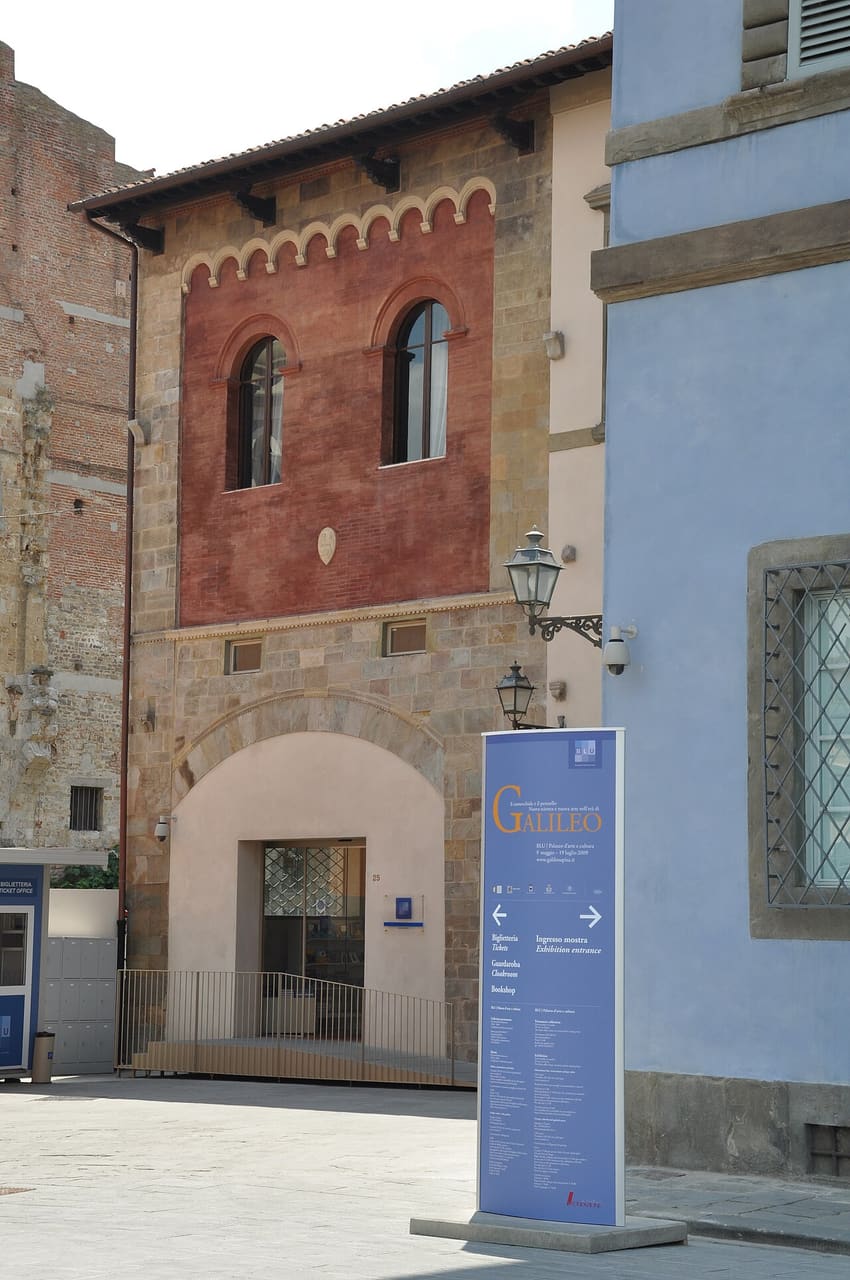
Step 6 of 8. Palazzo Blu counts twice: from outside, and inside, for the collections or an exhibition. The operator’s page indicates access from the hall on the lungarno and keeps the visiting conditions separate: before you take the ticket, read what it covers. It does not necessarily apply to every exhibition.
Step 7 of 8. Keep a way out: if the interior is closed, full or on conditions that do not suit you, take an exterior near your route, or drop a stop. If you have mobility needs, check the entrance and the route first. Plan your break separately: a cultural point does not tell you what facilities you will find there.
Step 8 of 8. After the first stops, stop and decide: carry on, or return? Before adding a place, put time, departure and luggage back into the count. The procedures for the train, the bus and luggage storage are in the linked cards; for arrival, First day in Pisa.
⚠️Avoid
Turning the collection into a list to be completed: it is not an itinerary.
Taking the climb for granted: the card does not confirm it, the structure decides it.
Entering courtyards or buildings because there is an artwork there: the point is not a permission.
Counting as two visits two cards that are the same complex.
Assuming that a ticket covers every collection, exhibition or service: read it first.
RUMBA S.r.l.
If an admission or the route does not fit your time, your budget or your needs, change stop before going on: a nearby exterior, or finish here. The collection guarantees neither availability nor duration.
🚲I’m travelling by bike in Pisa: how do I plan my route, parking and water?
Decide where you are going and by what time you need to arrive or get back. Check the route on the cycle-lane map of the Comune di Pisa. The collection covers the rest: a bike rack near your destination, a water point, a place to stop. The points are not a plotted route.
Do this
Step 1 of 8. Mark your start, your destination and the time by which you need to arrive or get back. If the bike is your own, decide where you leave it during your stop. If it is rented, ask the operator where and how it is returned; if it is a shared bike, the app tells you: just any bike rack does not end the rental.
Step 2 of 8. Check the route on the cycle-lane mapping published by the Comune di Pisa: Pisamo points there too. Look at where the lane ends and how you cross to reach your destination. The collection is no help here: it is a list of points, and it does not tell you whether the street between two points can be cycled.
Step 3 of 8. Open Bike racks and choose the one that is handiest for your destination, looking at the actual route. Keep a second one ready: on site you may find the first one full or unusable. The point on the map tells you where the rack is, not whether there is space today.
Step 4 of 8. Lock the bike to the rack, not next to it. Pisamo describes removals of bikes parked outside racks in the station area and notices for works on the racks: read the notices on site. Before you walk away, check how you have locked it and note where you left it.
Step 5 of 8. The Water section leaves out points with a recorded fault or access restriction, but it does not tell you whether the water runs today: open the card, read the source and the known conditions, and on site read the signs before using it. Acque’s dispenser map covers that operator’s facilities, not every point in the collection.
Step 6 of 8. For your break, open Where to stop: these are parks. Find the entrance and read the signs on access, use of the area and bikes: a park in the collection does not mean you can cycle inside it. Shade, seating and other services are not confirmed: stop where it suits you even without them.
Step 7 of 8. At your first stop, take stock: tiredness, weather, time left. If the next stretch is not suitable, change your way or end the outing here. If something is wrong with the bike, look first for the rental operator’s assistance, if there is any, or a suitable service; then decide whether to carry on.
Step 8 of 8. Before you extend the outing, work out your return again: the route, the time, the handover if the bike is rented. If you are getting back by train or bus, ask the carrier whether the bike can come aboard and on what conditions: the regional train card and the bus card deal with tickets, not with the bike. For luggage there is the luggage storage card; for your arrival, First day in Pisa.
⚠️Avoid
Reading bike racks, water and parks as an already plotted cycle lane.
Applying another service’s parking or handover rules to your bike, scooters included.
Leaving the bike without reading the notices on site because the rack is on the map.
Setting off counting on a single water point, or on one whose conditions you have not read.
Taking for granted that every train or bus takes the bike on the same conditions.
RUMBA S.r.l.
If you cannot find a route or a stop that suit you, change your destination before carrying on. If the problem is the bike or its handover, check with the operator or an assistance service; and before you add a stop, work out your return again.
Buy your ticket only through the channels the club indicates, and bring an ID document: the ticket is issued in your name. If you can, arrive on foot, by bike, by train or by bus: two hours before kick-off, the ZTL Stadio (the stadium's Limited Traffic Zone) comes into force at Porta a Lucca, and many streets have parking bans. Read the Municipality's notice for your match.
Do this
Step 1 of 8. Buy your ticket only through the channels the Pisa Sporting Club indicates: the club states the Ticketone network, online or at the Pisa Store, Tifo Pisa in Fornacette and RGM Sport in San Giuliano Terme outlets. The ticket is issued in your name: if someone else is going instead of you, the name change is done through the Ticketag platform, to someone holding a Pisa Membership Card.
Step 2 of 8. Before buying, open the match's ticket page on the club's website. For some matches you need the Tessera del Tifoso (a supporters' loyalty card scheme), because the Membership Card alone is not enough. For some matches, sales in the home sections are also restricted to residents of Tuscany, or supporters of the away team can only buy in the away sector, following their own club's rules.
Step 3 of 8. If you have a 100% disability rating, reserved seats are requested through the club's accreditation, by the deadline set for each match; your companion gets in free. If you hold a disabled parking permit (CUDE), the Municipality lets you register on Pisamo for authorisation to drive into the ZTL Stadio on match days, even if you don't live in Pisa. For some matches designated by the club, children under 14 accompanied by a parent get a free ticket, to be collected in person at the sales points; the accompanying adult pays the full ticket price.
Step 4 of 8. Bring a valid ID document: the stadium regulations require you to show it to staff so they can check it against the name on the ticket. Bags may be inspected at the entrance. Glass, cans, plastic bottles, umbrellas that don't fold into a pocket, helmets, flag poles, bulky luggage and animals are not allowed in, except guide dogs.
Step 5 of 8. The regulations published by the club state that the gates normally open two hours before kick-off; for some matches the club announces its own timing. The same regulations explain that entry is staggered over at least 90 minutes and recommend arriving as early as possible, to avoid long queues. Your sector (Curva Nord, Curva Sud, Gradinata or Tribuna) is written on the ticket. Check the match page anyway: checks are carried out at the gates.
Step 6 of 8. If you can, come without a car. On the map, the nearest station is Pisa San Rossore, on the Lucca-Pisa and Pisa-La Spezia-Genova lines. From Pisa Centrale the club points to the CPT bus (routes on cpt.pisa.it); from the airport, the PisaMover takes you to Pisa Centrale in under three minutes. On match days some routes may be diverted: check the Autolinee Toscane notices. For bikes there's CicloPi. For taxis, the Pisa radio taxi service (Co.Ta.Pi.) can be reached on 050 541600 and has a fixed stand on via Rindi, in the stadium area: after the match, book by phone or app instead of looking for a free one on the street.
Step 7 of 8. By car: for every home match of the 2026-27 season, the ZTL Stadio is in force at Porta a Lucca, with the cameras switching on two hours before kick-off. The Municipality states they stay active until the end of the first half, while Pisamo says until the end of the match. If you're not authorised, leave the car outside the zone: the Municipality lists the via Pietrasantina car park as free. According to the Municipality, motorbikes and scooters can enter freely.
Step 8 of 8. For every match the Municipality also imposes parking bans with towing and street closures around the stadium: for Pisa-Roma, for example, the closures lasted until the crowd had dispersed. The streets and the duration change from match to match: read the notice in the News section of the Municipality's website, and the sign on the street is what counts. On the way out, follow the stewards' directions; if you feel unwell or see someone in difficulty, ask for help and, in an emergency, call 112.
⚠️Avoid
Buying the ticket outside the channels the club indicates: it's issued in your name, and changing the name has its own procedure.
Driving into Porta a Lucca in the two hours before the match without authorisation: the ZTL Stadio has cameras.
Leaving the car in a street with a match-day ban: towing is provided for.
Turning up at the gates without an ID document or with prohibited items.
Assuming the times and streets from another match still apply: orders and opening times change every time.
RUMBA S.r.l.
If you can't find the notice for your match, or you're not sure whether you can drive in, leave the car outside Porta a Lucca and arrive on foot, by bike or by public transport. For an emergency, open SOS or call 112.
Everything is within 1.2 km of Porta a Lucca, the city-wall gate closest to the stadium. On match day, streets and car parks change: the map shows where things are, not whether you can use them.
On match day the ZTL Stadio is active at Porta a Lucca and many streets have parking bans with towing: before looking for a space, read the Municipality's notice for the match.
Two hours before kick-off, the ZTL Stadio (the stadium's Limited Traffic Zone) comes into force: only authorised cars can enter. If you live or are domiciled in the area, the permit is free and is requested on Pisamo. For every match the Municipality also adds parking bans with towing and closures: read the match notice.
Do this
Step 1 of 8. Check Pisa Sporting Club's home fixture list: the ZTL and the bans only apply on those days. The club publishes the 2026-27 fixture list on its website, and the Municipality announces when the ZTL is activated.
Step 2 of 8. For every home match of the 2026-27 season, the ZTL Stadio cameras switch on two hours before kick-off. The Municipality states they stay active until the end of the first half, while Pisamo says until the end of the match: if in doubt, treat the zone as closed until the match ends.
Step 3 of 8. If you live or are domiciled within the perimeter, register on the Pisamo portal with SPID or CIE: the permit is free. If you live within the perimeter, you need the car's registration document: your own, on loan for use, or belonging to your household. If you are domiciled there, you need the registered tenancy agreement or the land registry extract, the registration document of a car belonging to your household, and a self-certification of your family status.
Step 4 of 8. Pisamo states that holders of a disabled parking permit (CUDE) can also request authorisation. Shopkeepers based in the ZTL can request it for themselves and for their customers, but not for their employees: the Municipality confirms that, as in all the other ZTLs, employees do not get an automatic permit. Don't confuse this authorisation for the ZTL Stadio hours with the Pisamo permit for commercial activities (180 euros a year, for loading and unloading from 7:00 to 20:00): they are two different permits, and you need the right one. The Municipality includes among those entitled the family members of people with severe disabilities and elderly people who need assistance. According to the Municipality, motorbikes and scooters can enter freely. If your situation is different, ask Pisamo before the match.
Step 5 of 8. If you drove in and parked in the zone before the cameras switch on, Pisamo states that you can leave whenever you want, even with the checkpoints active: this applies to the ZTL, not to any match-day parking bans with towing (see the next step).
Step 6 of 8. For every match the Municipality also imposes parking bans with towing and street closures around the stadium. For example, for Pisa-Roma (30 August 2025) the ban ran from 8am to midnight in via Rosmini, via Santo Stefano, via Rindi, via Bianchi and piazzale Rosmini. Streets and times change every time: read the match notice, and the sign on the street is what counts.
Step 7 of 8. If you work or pass through the area around Piazza dei Miracoli, the measures can reach that far too: for Pisa-Roma the Municipality had suspended the tourist trains and closed via Contessa Matilde from 6pm for the teams' arrival. Read the notice even if you're not going to the stadium.
Step 8 of 8. For the ZTL and permits, Pisamo is the point of contact: phone 050 7062, Monday to Friday from 9 to 13:15 and from 14:15 to 17, or frontoffice@pisamo.it. These hours are on weekdays only: for a weekend match, call ahead.
⚠️Avoid
Relying on having authorisation without checking that the number plate is registered on Pisamo.
Leaving the car in a street with a match-day ban: towing is provided for.
Using the times or streets from another match: orders and times change every time.
Assuming the streets reopen at the final whistle: closures can last until the crowd has dispersed.
Waiting until match day to ask Pisamo: the office only answers on weekdays.
RUMBA S.r.l.
If you can't find the match notice or you're not sure whether your car is authorised, don't drive into the zone in the two hours before kick-off, and call Pisamo on a weekday. For an emergency, open SOS or call 112.
Car parks, bikes and taxis within 1.2 km of Porta a Lucca. On match days the area has the ZTL Stadio and parking bans: the map shows where things are, not whether you can use them.
🚌I need to take the bus in Pisa: which ticket do I need, where do I buy it, how do I validate it, and which line goes to the Tower, the hospital, the University or the sea?
In the city you need Autolinee Toscane's «urbano capoluogo» ticket: 2.00 euros, valid for 70 minutes from validation. Buy it before boarding, on the at bus app, at ticket machines or at a retailer. Or pay on board with a contactless card, where there is a reader. Validate as soon as you board. You find the line, the stop and the last run in the at bus app: AT lists no night lines for Pisa.
Do this
Step 1 of 8. Before you go out, open the Travel Planner in the at bus app: it tells you the line, the stop, the direction of travel and real-time arrivals. AT groups the station stops under «PISA stazione». Then read the Pisa notices on at-bus.it: diversions and suspended stops change often. During a strike, the AT notice for that strike is what counts. The 2026 Service Charter lists full service from 4:15 to 8:14 and from 12:30 to 14:29. Announced strikes are also on the Ministry of Transport website. A strike does not entitle you to a refund.
Step 2 of 8. In the city you need the «urbano capoluogo» ticket: 2.00 euros, valid for 70 minutes from validation. The 10-ride carnet costs 18.20 euros. These are the AT fares in force since 1 August 2026. Tickets bought earlier are valid until 31 January 2027. If you take the bus every day, look at the urban passes: monthly 42.20 euros, quarterly 104.50, annual 342.80, student annual 278.70. With an ISEE (the Italian family income indicator) there are reduced fares. Always carry your Tessera Sanitaria (Italian health card): AT checks passes against your codice fiscale (tax code).
Step 3 of 8. You can buy it on the at bus app, at automatic ticket machines, at retailers or at the AT ticket office at Sesta Porta, via Cesare Battisti 53. The ticket office is open every day until 19:45, closed on 25 December, 1 January and Easter. By SMS the ticket costs 2.40 euros, plus 0.29 euros for the SMS request: text PISA to 4880105 at least 2 minutes before boarding. At an inspection you show the QR code from the link. AT lists only Italian carriers (TIM, Vodafone, WINDTRE, Very Mobile, Fastweb): with a foreign number, use the app or your card. Bought from the driver, it costs 3.00 euros, sales may be suspended and the driver does not have to give change.
Step 4 of 8. Almost all buses have the tip tap reader: you recognise it by the sticker on the bus. You pay with a Mastercard, Visa or American Express card, or an enabled smartphone or smartwatch. AT says the price is not marked up. Maestro and VPAY are not accepted. On urban lines (green) tap every time you board. On mixed (orange) and extra-urban lines tap when you board and again when you get off. Red light: the payment failed. One card pays for one person only. If there is no reader or it doesn't work, you need another ticket.
Step 5 of 8. Stops are on request: to get on, wave the bus down. Board through the front door, unless told otherwise, and validate straight away. Keep your ticket intact until you get off. A ticket bought on the at bus app must be activated when you first board: buying it and showing it is not enough. At an inspection you show a digital ticket on the phone you bought it with; for tip tap, show the card or device you used. If the validating machine doesn't work, write the date and time on the ticket in pen and tell the driver right away. With a carnet, keep the stub behind ticket number 1. To get off, press the bell and use the middle or rear door.
Step 6 of 8. The line colour tells you the fare: jade green urban, orange mixed, blue extra-urban. For Piazza dei Miracoli take the 1+ or the 21 and get off at TORRE DI PISA 1 or 2, depending on the direction. The 26 also passes there, and AT lists it as running all year for the San Rossore Park. For Cisanello Hospital: 1+, 13, 14 or 22. For the University's Polo Fibonacci: line 4, stop on via Buonarroti. For other university sites AT publishes no list: look them up in the Travel Planner.
Step 7 of 8. For Marina di Pisa, Tirrenia and Calambrone take the 10 or the 20 from Sesta Porta. The urban ticket is valid as far as D'ANNUNZIO NAVIGLIO: beyond that you need an extra-urban ticket. Two AT pages describe the «Litorale Pisano» fare differently: check it in the at bus app before buying. With the winter timetable from 15 September 2026, every day, the last 21 leaves the station at 23:17. The last one from TORRE DI PISA 2 leaves at 23:53. The 20 leaves Sesta Porta at 22:00 and 23:30; the 23:30 one goes only as far as Tirrenia. It returns from Tirrenia at 22:55 and 00:07. On 31 December the weekday evening runs do not operate.
Step 8 of 8. You can carry one bag free up to 105 cm (sum of the three dimensions) and 10 kg, if it does not take up seats. Bikes and scooters are allowed only folded. Children under 11 travel free, one per adult. Pushchairs board through the middle door. One animal per passenger travels free: dogs on a lead and muzzled, except guide dogs. In a wheelchair, book a bus with a ramp 48 hours ahead: 800 14 24 25, every day from 8:00 to 20:00, or the online form. Wait for confirmation. AT guarantees the service only if it has buses with ramps and the stops are equipped. The driver sets up the ramp but does not help you board.
⚠️Avoid
Travelling without a validated ticket. On urban lines you pay 40 euros plus 3 if you settle within 15 days, 80 plus 3 up to day 60, 240 plus 3 after that. On extra-urban lines 60, 120 or 360 euros, plus 3.
Forgetting to tap when you get off a mixed or extra-urban line: you pay the fare to the end of the line.
Paying for two people with the same card: tip tap covers one passenger only.
Going towards the sea beyond D'ANNUNZIO NAVIGLIO on an urban ticket: from there you need an extra-urban one.
Assuming the 21 will take you to the airport terminal. The 21 has a «Via dell'Aeroporto» stop, but we have not checked the route or the distance between that stop and the terminal. Between the station and the terminal, the documented connection is the PisaMover.
RUMBA S.r.l.
If you have missed the last run, don't wait at the stop: go to a taxi rank or call the Co.Ta.Pi. radio taxi on 050 541600, available 24 hours a day. From the Pisa Centrale rank, the City of Pisa's sign gives fixed prices: 10.80 euros to Piazza Duomo or Piazza Manin, 12.00 to Cisanello. If you feel ill on board or at the stop, are robbed or see someone in danger, tell the driver, open SOS or call 112.
Everything is within 1 km of Pisa Centrale station, where many urban lines stop. The map shows where things are, not bus stops, timetables or today's diversions. Ticket retailers are not on the map.
✈️From Pisa airport to the city centre46 places · 5 sections
✈️I've landed at Pisa airport: how do I get to the station or the centre, how much does it cost, and what do I do if I arrive at night or travel with luggage, children, a bike or a disability?
Take the PisaMover: it leaves less than 40 metres from the terminal and reaches Pisa Centrale in about 5 minutes. A ride costs 6.50 euros. The operator says it runs from 6:00 to 24:00. Early in the morning and late in the evening, rides are on request: allow for a wait. The taxi rank at arrivals operates 24 hours a day, with fixed prices to the station and the centre. The airport's bus page lists no urban buses to the centre.
Do this
Step 1 of 8. The PisaMover leaves less than 40 metres from the terminal, next to Gate B – City Gate. It reaches Pisa Centrale in about 5 minutes, with one stop at San Giusto/Aurelia. The operator says it runs every day from 6:00 to 24:00, and until 1:00 from June to September. During the day it runs every 5.7-9 minutes. Before 8:00 and after 21:00 it runs every 12-15 minutes, with rides «by specific call»; from November to March, before 9:00 and after 20:00. The operator does not explain how to request a ride and states there are no booking services: ask the staff.
Step 2 of 8. A ride costs 6.50 euros, return 13.00. Families, up to two parents and three children, pay 5.50 euros per parent and 4.50 per child. Groups of at least 10 people pay 5.00 each. A child up to one metre tall travels free with a paying adult, one per adult. The monthly pass costs 20 euros. These are the 2026 fares from the Service Charter. Buy at the machines, 4 per station, or online, then go through the turnstiles. The operator does not say which payments the machines accept. For questions there is the call centre 050 500 909, Monday to Friday 8:30-18:00.
Step 3 of 8. On the PisaMover, luggage travels free, on the floor or in the dedicated areas, never on seats or in the aisles. If the car is full, it may be refused. An open pushchair with the child in it must be secured in the wheelchair area. Animals travel in a carrier the size of hand luggage, with an ordinary ticket; dogs may also travel outside one, muzzled and on a short lead. At the airport, the left-luggage office is open from 8:00 to 20:00: 10 euros a day under 70 cm, 15 over, 25 for bikes or oversized items. The airport does not say where it is. If your bag doesn't arrive, report it to Lost & Found in the baggage reclaim hall, 8:00-21:00.
Step 4 of 8. If you continue by train, on Trenitalia choose «Pisa Aeroporto» as departure or arrival: the ticket includes the PisaMover, with a 6.50-euro share that gets no discount. On Trenitalia channels the PisaMover can be bought only together with the train. Train and shuttle remain two separate contracts: complaints and refunds go to whoever runs each leg. At Pisa Centrale the PisaMover is at platform 14: follow «AEROPORTO / AIRPORT». From outside, enter from via Quarantola. For Lucca and Florence, train times are on the Trenitalia website.
Step 5 of 8. The taxi rank is in front of the airport, on the arrivals side, operating 24 hours a day with the Co.Ta.Pi. cooperative. The City of Pisa's sign gives fixed prices, surcharges included: 10.80 euros to Pisa Centrale, 14.50 to Piazza Duomo or Piazza Manin, 14.50 to Cisanello Hospital. Co.Ta.Pi. specifies they apply only if you take the taxi at the rank. For other destinations the meter applies, and it must be switched on for every ride. With the radio taxi, 050 541600, you pay by the meter plus surcharges. Co.Ta.Pi. lists cars with card terminals: if you pay by card, say so before getting in.
Step 6 of 8. The airport's bus page lists no urban buses to the centre. The Sky Bus Caronna to Florence leaves from bus area P6, about an hour's journey. AT line 21 has a «Via dell'Aeroporto» stop, 4 minutes before PISA stazione, but AT does not say how far it is from the terminal. The airport says the station is about 1 km away; the PisaMover track is 1,760 m long. No official source describes a walking or cycling route, and the map does not suggest one. On the PisaMover one bike per car is allowed, fixed to the anchor point. At the station use the lift, never the stairs.
Step 7 of 8. If you land late, compare your arrival time with the end of PisaMover service: 24:00, or 1:00 from June to September. From 21:00, and from 20:00 between November and March, rides are already on request. After closing, no official source we have read lists a bus from the airport to the centre: the option this guide has verified is a taxi. The taxi rank at arrivals operates 24 hours a day. If there are no taxis, call the radio taxi on 050 541600 or use the Taxi Move app. To book one by SMS or Telegram (city, street, house number), you will find the number and instructions on the Taxi Message page of the Co.Ta.Pi. website. A taxi called this way is paid by the meter.
Step 8 of 8. Assistance at the airport is free: request it from the airline, agency or tour operator when you book, or at least 48 hours in advance. If you didn't request it, go to the airport staff anyway. On arrival, staff accompany you to the taxis, bus stops or the PisaMover. The PisaMover takes one wheelchair per car and the stations have lifts, ramps and tactile paths. For the train, book RFI's Sale Blu assistance: 800 90 60 60 only from a landline in Italy; from a mobile or from abroad +39 02 32 32 32, at the standard rate. The Sale Blu take bookings from 6:45 to 21:30. Pisa Centrale is a Fast station: if you ask by phone or in person, 1 hour's notice is enough for assistance between 7:45 and 22:30; outside those hours you need 12. If your journey includes a Standard station, you need 12 hours' notice for that station: ask for the assistance to be confirmed for the whole journey. Co.Ta.Pi. has seven taxis with ramps, available from 4:00 to 24:00: book them, preferably 24 hours ahead.
⚠️Avoid
Waiting in front of the terminal for an urban bus to the centre: the airport's bus page lists none.
Calling the radio taxi and expecting the fixed price: it applies only if you take the taxi at the rank.
Counting on a scheduled PisaMover in the evening: from 20:00, or from 21:00 between April and October, rides are on request. After closing, the option this guide has verified is a taxi.
Asking Trenitalia for a refund of the PisaMover leg: train and shuttle are two separate contracts.
Setting off on foot towards the station at night, perhaps with luggage, without a verified route: no official source we have read describes one. The options this guide has verified are the PisaMover, while it is running, and a taxi.
RUMBA S.r.l.
If you have arrived at night, the PisaMover is closed and there are no taxis at the rank, stay near the terminal and call the radio taxi on 050 541600: that is the option this guide has verified, while we have not verified a walking route. If you feel ill or are in danger, open SOS or call 112.
Everything is within 2 km of the airport PisaMover stop, as far as Pisa Centrale station. The map shows where things are, not whether a service is running now, nor a walking route.
The left-luggage offices on the map are near Pisa Centrale: the airport one is not shown. The map doesn't know whether they are open today or have space.
Pisa has its own measure. Four routes to observe its material, time and details.
Who is Perligio?
Perligio looks at the city close up: materials, façades, signs, real opening hours, the way time settles on things. It does not review or rank: it picks a few places and explains what to look at, in what order, and why.
A RUMBA S.r.l. brand, like perdiqua: it signs these selections, it does not decide the map order, and no venue pays to appear here.
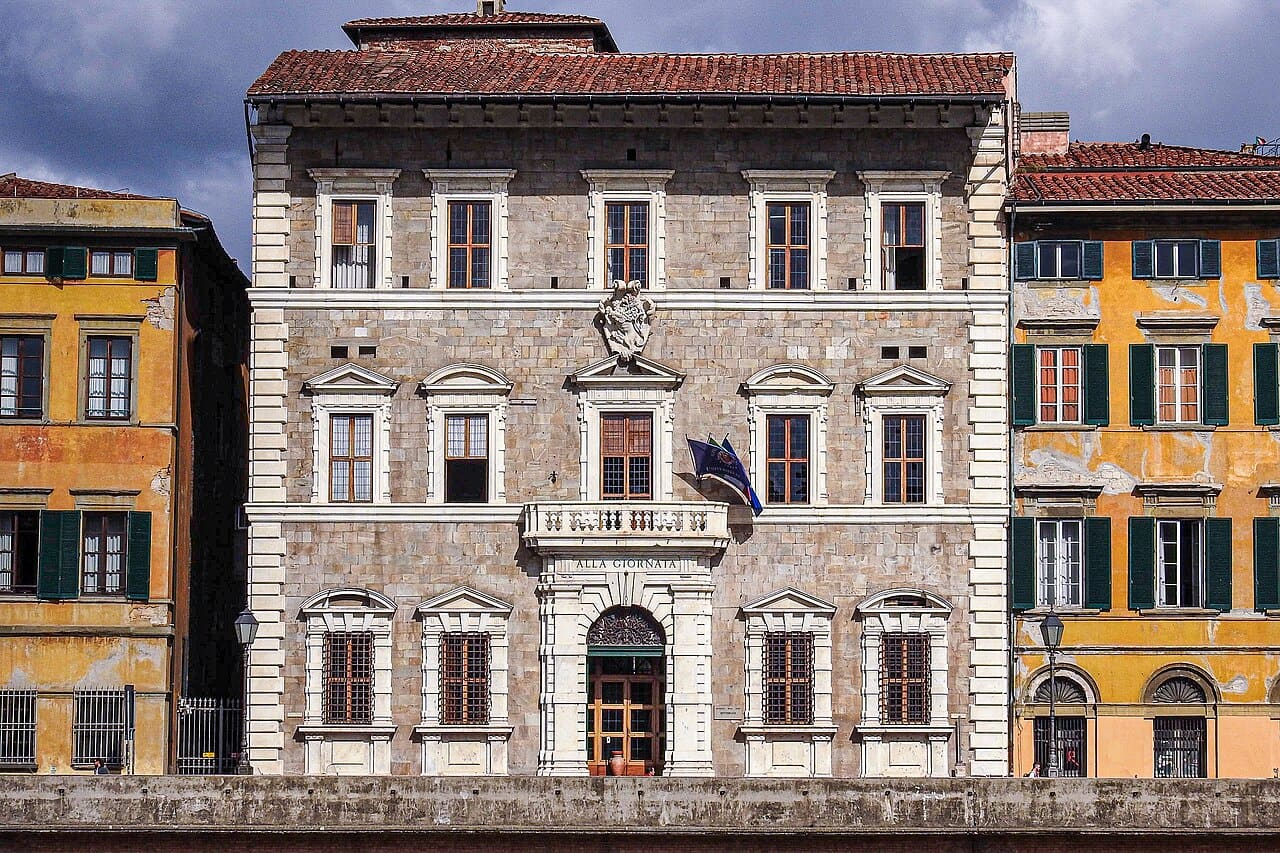
Foto: Antonio D'Agnelli / Wikimedia Commons · Pubblico dominio01
🛣️Perligio routeThe measure of the cityPalazzo alla Giornata · Chiesa di San Nicola · Osteria dei Cavalieri
I want to observe façades and details in Pisa: how can I follow The measure of the city?
Start with a detail: the motto on Palazzo alla Giornata or the lunette of San Nicola. Compare shapes during a walk, then consider a stop at Osteria dei Cavalieri. Exteriors are the thread of the visit; entering a building or having a meal requires a separate choice.
Do this
Step 1 of 8. Choose the first detail that interests you and look at how to reach it from your location. Keep the time for observing façades separate from the time for a possible meal.
Step 2 of 8. On Lungarno Pacinotti, locate Palazzo alla Giornata and look for the motto and chain above the entrance. The municipal page explains the inscription and interpretations connected to its history: start with what you can recognise on the façade.
Step 3 of 8. The municipality identifies Palazzo alla Giornata as the University of Pisa Rectorate and notes architectural barriers. To observe the detail, stay in the passage areas; if you want to enter, first check access to the building and whether it meets your requirements.
Step 4 of 8. Go to the Chiesa di San Nicola on Via Santa Maria and look for the lunette on its façade. The municipal tourism source presents a study relating its geometry to the Fibonacci sequence: use it as a way of looking, without having to reconstruct the calculations.
Step 5 of 8. Compare circles, arches and proportions from outside. If you want to enter the church or visit the bell tower, check the specific conditions: observing the façade does not include a climb. Respect any services and the instructions on site.
Step 6 of 8. For Osteria dei Cavalieri, look for Via San Frediano 16. The operator describes the entrance dining room as the base of a tower house; if you want lunch or dinner, check the menu, prices and availability through the venue's contacts.
Step 7 of 8. If you choose to stop at the osteria, observe how the stone of the setting accompanies its current use. You can also end the walk after the façades: a meal is not necessary to follow the collection's theme.
Step 8 of 8. Before adding a detour, compare the time remaining with your departure point. For trains, buses or luggage, use the relevant guides; First day in Pisa helps you organise your arrival.
⚠️Avoid
Do not regard the Rectorate building as a freely visitable space.
Do not turn the source's geometric interpretation into automatic proof of the original intention.
Do not confuse seeing the bell tower with being able to climb it.
Do not count on a table or a price without checking.
Do not transfer one building's conditions to the other places in the collection.
RUMBA S.r.l.
If admission or a meal does not suit your time or requirements, stay with observing exteriors or end the walk. Change the connection when the passage you chose is unsuitable.
Foto: Federigo Federighi / Wikimedia Commons · CC BY-SA 4.002
🛣️Perligio routePaper, mark, materialMuseo della Grafica · Blu Book · Cavalieri Specialty Coffee
I am interested in paper, drawing and materials: how can I organise these three stops in Pisa?
Decide how much time to spend at the Museo della Grafica, then link Blu Book with a possible break at Cavalieri Specialty Coffee. The theme is observing how a mark, a book and a setting take shape; museum admission, purchases and refreshments are arranged separately.
Do this
Step 1 of 8. Decide whether to enter the Museo della Grafica or focus mainly on the walk. Put the visit that requires a particular time first in your plans, leaving room for the other two stops and the return journey.
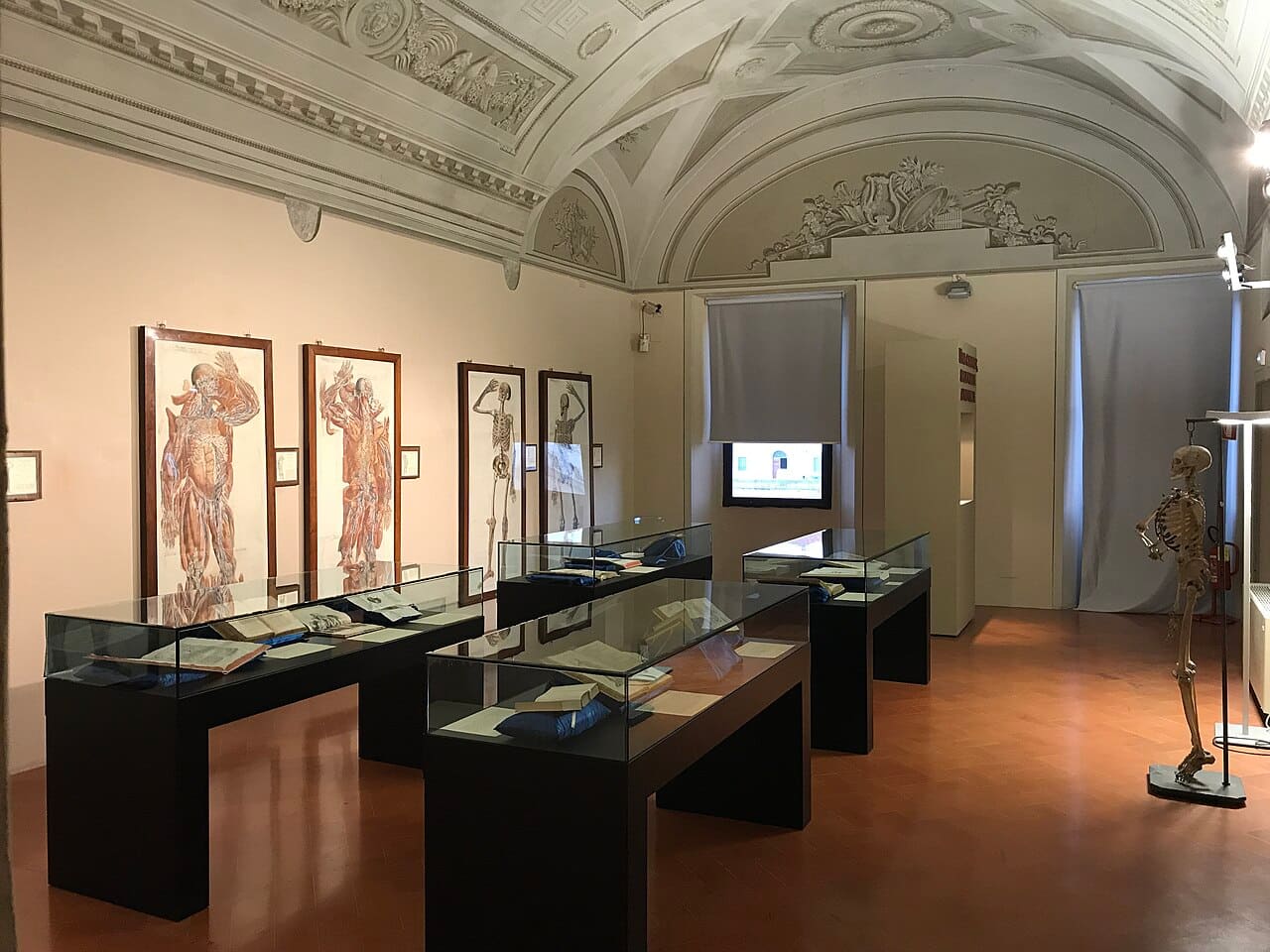
Step 2 of 8. Open the Museo della Grafica source and follow the link to the museum website for the programme, admission and tickets. The municipality describes the contemporary graphic art collection at Palazzo Lanfranchi, on Lungarno Galilei; choose what to see according to that day's programme.
Step 3 of 8. During the visit, spend time looking at a drawing or print and then at a detail of the building. You can compare how a line creates an image with how walls and openings organise a room, following the instructions in the galleries.
Step 4 of 8. For Blu Book, use the name and the address Via Pietro Toselli 23. The bookshop website presents art publications, catalogues, books about the area and temporary exhibitions: choose a subject to look for, without counting on a particular title being available.
Step 5 of 8. If you want a particular catalogue or book, ask the bookshop whether it is available and at what price. For an exhibition, check the current programme. Browsing and making a purchase remain two separate choices.
Step 6 of 8. On its operator's website, Cavalieri Specialty Coffee is presented as being inside Palazzo Feroci, with historic rooms and an open kitchen. If you want to stop, check the service, menu and availability for your chosen time: the café is a possible break, not museum admission to the palazzo.
Step 7 of 8. Compare the route between Lungarno Galilei, Via Pietro Toselli and Palazzo Feroci on the map. For entries without an associated point, use the address from the venue's source; check the entrance and route if you have mobility requirements.
Step 8 of 8. After the second stop, decide whether to continue or leave the break for another occasion. Keep time to reach your departure point and collect any luggage; the train, bus and luggage storage guides help you organise your return.
⚠️Avoid
Do not assume that a particular work is on display just because it belongs to the museum collection.
Do not assume that a book or a seat is available without checking.
Do not treat the museum, bookshop and café as a single admission or service.
Do not infer the route from the order of the entries alone.
Do not assume that discounts, bookings or services are included in the collection.
RUMBA S.r.l.
If the visit or break is not available within the time you have, keep the other stops or reduce the programme. Before travelling to visit an interior, check the conditions at your chosen place.
Foto: Taccolamat / Wikimedia Commons · Pubblico dominio03
🛣️Perligio routeTime upon thingsPalazzo Toscanelli · Terme romane · Gipsoteca di Arte Antica
How can I recognise different periods and uses in the places featured in Time upon things?
Link Palazzo Toscanelli, the Roman baths and the Gipsoteca by choosing a detail for each: a memory, a remnant and a change of use. Plan any visit to the Gipsoteca first, then adapt the walk to the time remaining.
Do this
Step 1 of 8. Decide whether to enter the Gipsoteca di Arte Antica. Consult the museum information for the programme, access and tickets before fixing the order of your stops; leave time to reach your departure point at the end.
Step 2 of 8. On Lungarno Mediceo, look for Palazzo Toscanelli. The municipal tourism source connects the palazzo with Lord Byron's stay: use its name and façade to recognise the place, without expecting access to the rooms as an automatic part of the walk.
Step 3 of 8. Read the entry as an invitation to distinguish the building's history from its present use. The municipal itinerary identifies it today as the State Archives: an archive service and a visit to the interiors have purposes and conditions that must be checked separately.
Step 4 of 8. Go to the Roman baths in Largo del Parlascio, also called Bagni di Nerone in the tourism source. Look for the brick structures and compare them with the site's description; observe from where passage is permitted, without going down among the remains to get closer.
Step 5 of 8. The municipal page distinguishes the name Bagni di Nerone from the dating of the baths and describes the nearby Bastione del Parlascio. You can look for differences between the structures without assigning everything you see to the same period.
Step 6 of 8. For the Gipsoteca, look for Piazza San Paolo all’Orto. The municipal source describes a collection of casts housed in the church building: if a visit is available, compare an exhibited sculpture with the space containing it, following the museum's instructions.
Step 7 of 8. At the end, choose a comparison between the three stops: a façade connected with a story, remains of a bathing complex, a church used for a collection. Distinguish the object you observe from its reproduction and from the place where it is displayed.
Step 8 of 8. Connect your current location with the return journey, checking the actual route and your mobility requirements. If you need to catch transport or collect luggage, consult the train, bus and luggage storage guides before adding another visit.
⚠️Avoid
Do not read every story connected with the palazzo as a verified fact.
Do not assume that the rooms mentioned in the building's history can be visited.
Do not attribute the baths to the emperor just because they are named Bagni di Nerone.
Do not regard the Gipsoteca's casts as the originals of the reproduced works.
Do not infer that the museum is open from the church's presence on the map.
RUMBA S.r.l.
If the Gipsoteca cannot be visited at your chosen time, you can keep the outdoor stops or postpone the museum part. Shorten the route when there is not enough time to observe and return without rushing.
Foto: LoneWolf1976 / Wikimedia Commons · CC BY-SA 3.004
🛣️Perligio routePisa after sixPalazzo Blu · Santa Maria della Spina · Radici
How can I organise Pisa after six without assuming museums and venues are open?
Choose whether to start with a visit to Palazzo Blu or with exteriors along the Lungarno. Then consider Santa Maria della Spina and dinner at Radici. The title suggests a time of day: check separately the last admission to places you want to visit and the restaurant's availability.
Do this
Step 1 of 8. If you want to enter Palazzo Blu, first check the opening times and last admission for your chosen visit. Plan your start around that condition, even by starting earlier: after six does not mean that every interior can still be visited.
Step 2 of 8. On the Palazzo Blu website, distinguish collections from temporary exhibitions and check the ticket required. The operator identifies the hall facing the lungarno as the entrance; choosing one visit does not automatically include all exhibitions.
Step 3 of 8. If you stay outside, use Lungarno Gambacorti to observe the façade and the building's relationship with the river. Choose where to stop without obstructing passage; you can continue even if you skip the indoor visit.
Step 4 of 8. Go to Santa Maria della Spina and look at the pinnacles, marble cladding and façade details. The municipality describes its dismantling and reconstruction at a higher level: this fact helps you read the relationship between the building and the river.
Step 5 of 8. Compare the building from places where passage is permitted and check your next route on the map. To enter, look for that day's conditions; an outdoor stop does not require you to include an interior in the programme.
Step 6 of 8. For Radici, use Piazza Carrara 16 and open the restaurant website. The operator presents Mediterranean cooking and its location in the square: consult menus, prices and contacts to check availability and conditions for dinner.
Step 7 of 8. From your location, identify the connection to Piazza Carrara, choosing a bridge and passages suited to your requirements. Allow time to reach the restaurant; if you skip dinner, you can end the walk without completing all the stops.
Step 8 of 8. Before sitting down to eat, check the return journey and any luggage collection. Use the train, bus and luggage storage guides to organise yourself, without inferring an evening service from a stop's mere presence on the map.
⚠️Avoid
Do not interpret after six as confirmation that every place is open.
Do not assume one ticket is valid for all exhibitions without checking.
Do not infer access to the church from observing its façade.
Do not regard dinner as included or a table as reserved by the collection.
Do not leave checking the return journey until after dinner.
RUMBA S.r.l.
If last admission has passed or dinner is unavailable, choose exteriors or shorten the evening. Keep the time you need for the return journey and check conditions before taking another detour.
How the map works: find the source and date on each card. “Take me there” opens walking directions. To report a fault, use the thumbs-down button beside “Is it working?”, when available.